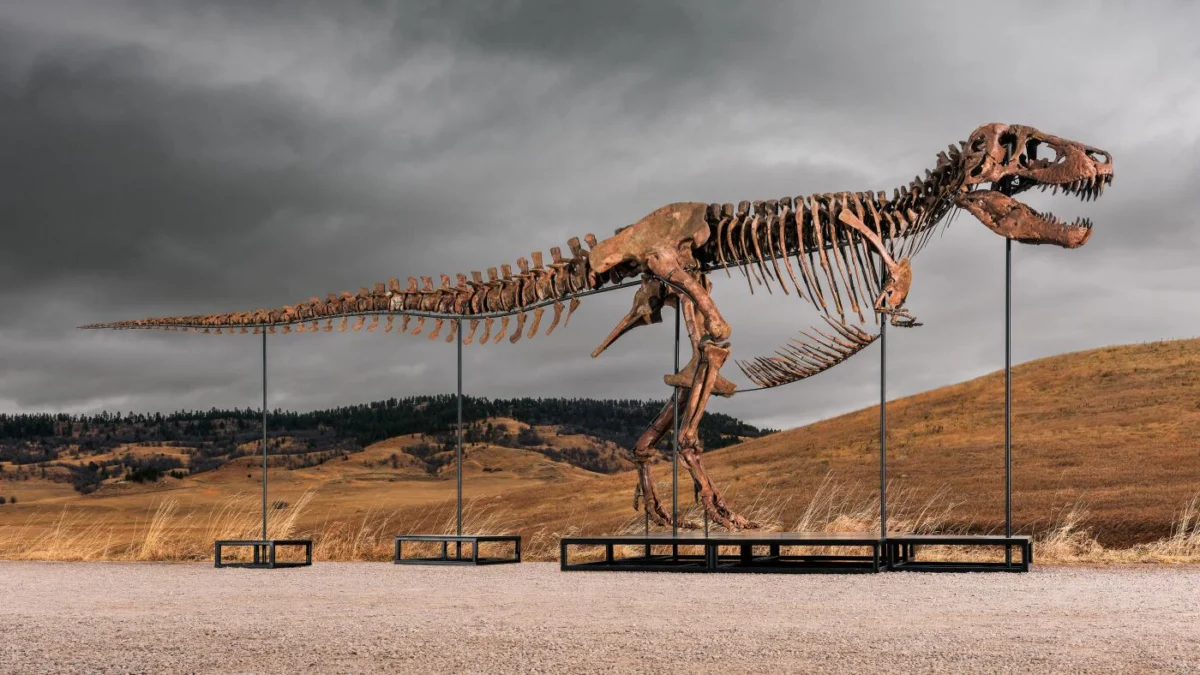
A Tyrannosaurus rex fossil known as “Gus” sold at Sotheby’s auction house for a record $50.1 million on Tuesday, a price that eclipses all previous dinosaur records and has sparked a heated debate within the scientific community about the privatization of such specimens. The sale, which followed a brief ten‑minute bidding war, is expected to be finalized by the auction house, Theropoda Expeditions (the excavators), and the landowners where Gus was discovered, with the proceeds earmarked to be shared among these parties.
The fossil, measured at roughly 38 feet in length and hailed as one of the most complete T. rex skeletons found to date, was expected by many in the field to be acquired by a museum. NPR contacted several major natural history institutions, including the Smithsonian, but none indicated they had bid on the piece. The decision by a private buyer to purchase Gus has led to widespread concern among paleontologists that such specimens may move out of public view or away from ongoing research.
The Society of Vertebrate Paleontology issued a strongly worded statement condemning the sale, arguing that “scientifically significant vertebrate fossils should be permanently curated in accredited museums, universities, and other public research institutions where they remain available for scientific investigation, education, and public exhibition.” One critic, Stuart Sumida, told NPR that auction houses like Sotheby’s and Christie’s are “complicit in removing data from the scientific process” by placing valuable specimens beyond the reach of researchers and the public.
Sotheby’s has defended the practice, noting that Gus was sold after a brief bidding session and that some proceeds will go to the excavators and landowners. A Sotheby’s spokesperson did not provide further comment in time for publication. In the past, Sotheby’s has said that buyers often intend to donate or dedicate specimens to museums, but the 2026 Gus sale has renewed questions about access for research when ownership is private.
Industry observers argue that the ecosystem around fossil hunting—where private collectors and commercial interests play a role—helps finance exploration and digs that public funds do not always cover. Walter Stein, a fossil hunter and owner of PaleoAdventures, contends that private investment is necessary to locate and preserve fossils that might otherwise weather away. He also notes that the field’s researchers sometimes face resource constraints when it comes to studying privately owned specimens.
However, experts like David Hone of Queen Mary University of London cautioned that even a high price tag does not guarantee scientific study or public access. He said it is unlikely the Gus specimen will be donated for long‑term research, and academia may not be able to compete with private wealth when it comes to studying such treasures. Hone also suggested that the money could fund a broader range of paleontological work if allocated differently, rather than securing a single high‑profile fossil.
Gus’s sale builds on a string of record prices for dinosaur fossils. Earlier auctions had already set records, with a Stegosaurus surpassing prior T. rex benchmarks in 2024, and a separate T. rex record dated back to 2020. These prices have intensified discussions about the balance between access for science and private ownership, a debate that touches on the valuation of natural history, museum funding, and the public‑benefit calculus of powerful collectors.
As the auction world continues to attract attention for selling public science heritage to private buyers, the scientific community is calling for clearer norms and safeguards to ensure that discoveries remain accessible for research and education. Critics argue that without public stewardship, the data embedded in fossils could be locked away, reducing the opportunity for future discoveries and understanding of Earth’s past.
The Gus sale thus crystallizes a long‑running tension: the role of private wealth in funding paleontology versus the imperative to keep scientifically significant specimens in museums and public institutions for ongoing study and public access. The next steps will depend on the terms of the sale and whether Gus can be evaluated or studied within a way that satisfies both scientific standards and private ownership realities.


